Showing posts with label music criticism. Show all posts

Sunday, 25 May 2014

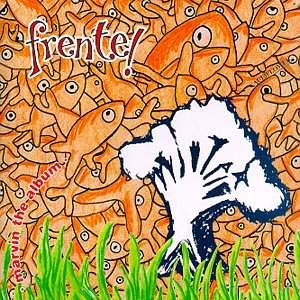
Album Review: Marvin The Album, by Frente!


Frente's debut album "Marvin the Album" has just been reissued, apparently in order to celebrate the fact that the record has just turned 21. I suppose Frente fans may rejoice at this - that is if they have time to do so in their hectic schedule of listening to brain-numbingly awful music, and watching twee rom-coms with all the perseverance of a dog eating its own shit.

As might be clear by this stage, I think re-releasing an album as bad as "Marvin The Album" under the pretence of being pleased by the fact it has been more than two decades since its hideous conception is behaviour akin to contracting a painful case of the boils in order to honour the fact that it's been 668 years since the peak of the Black Plague.

If albums were items of clothing, "Marvin The Album" would be a half-finished sweater knitted by an old woman fighting the ravages of Alzheimer's. Sure, it's kinda cute, but only in a way that makes you pity the brain-dead human beings that are responsible for its creation.

One of my favourite songs of recent years is a track by Father John Misty called "Now I'm Learning to Love the War" which begins with Misty singing: "Try not to think so much about/The truly staggering amount of oil it takes to make a record. All the shipping, the vinyl, the cellophane lining/The high gloss, the tape and the gear."

It's a song I used to find funny, but now my laughter has died sourly in my throat. Because, while listening to "Marvin the Album", I found I couldn't stop thinking about the oil that went into releasing this festering excuse for music not once but twice.

The copy I plucked from my local JB-Hifi was one of a dozen, and I have a bad feeling that there might be another crateful or two sitting in the store's backroom, lying in wait like a mousetrap in a fake box of chewing gum, or a serial killer lurking inside an ice-cream van.

 
Frente - a band whose dedicated attack on good music is equalled only by their desire to come across as the biggest twats imaginable on stage, as evidenced by the clip above.

The album is so lifeless and 'cute' it might have been recorded by an android fashioned to look like Zooey Deschanel. It's the kind of shit you might put on a mixtape for your beloved, if you were a six year old whose head had been trapped in a vice grip from birth.

Some have accused Arcade Fire of  releasing White Person music - that is, the tunes a pretentious Uni student uses to score their home movies - but honestly, next to Frente, Arcade Fire are Niggas With Attitude. From start to finish "Marvin the Album" is a simpering mess - the music is so cutesy that immediately after I played the whole thing through once I had to resist the urge to go out and punch the first passing kitten or small child.


"Here's a door and here's a window/here's a ceiling, here's a floor" are the first lines of "Accidentally Kelly Street", proving that if you start off your song sounding like a three year old explaining the lay out of her playroom to a blind person, you should probably give up writing lyrics and stick to sucking on batteries.

I'd really love to shove the members of Frente in a room with a band as good as Black Flag were in their heyday and force them to discuss what they think is the purpose of music.

Although I'm sure Henry Rollins would be an arse about it, I bet he'd say that for him music is a way to administer social change - a kind of primal anthem designed to shock us from the zombie like suffering of life under capitalist rule.

Whereas, I have no doubt that the only argument to come out of the mouth of Angie Hart, Frente's lead singer (although, labelling her as such is like calling that drunk who sits next to you on the bus and garbles on about race relations a 'Wine Connoisseur') would be that it's a way of getting cute boys wearing glasses with plastic lenses to notice you during your lonely nights at Art Class.

Please don't buy this album. If you really want to waste your money, spend it on edible toilet paper, or a jar of Tony Abbott's respect for women.

Friday, 25 April 2014

Live This Sound: A Sea of Split Peas

 
Every once in a while, a record comes around that consumes you. It fills your waking hours. You think about it during the day, and you play it on constant repeat at night. You want to watch it; to read it; to swallow it whole.  Live this Sound is a regular section of this site that allows you to experience a single album as many ways as you possibly can. This week, we take a look at A Sea of Split Peas, the double EP from rising Aussie star Courtney Barnett.
 
The Album.


Courtney Barnett's total world domination has ramped up another notch recently, with the slyly witty young songstress making an appearance on The Tonight Show with Jimmy Fallon. There's no use mistaking the fact that the Melbournian is our Next Big Thing - it's become increasingly hard to turn on the radio without coming across one of her grungy, tongue in cheek ballads. Thank God then that Barnett is a fantastically talented singer/songwriter - otherwise it'd be easy to get pretty sick of her, pretty quick.
 
Barnett's Double EP A Sea of Split Peas walks a fine line between tragedy and comedy - a song like "Avant Gardener" combines both, without ever becoming melodramatic or self-pitying.
 
But while rushing to appreciate her lyrics, it's easy for one to overlook the fact that she rocks as well. Her album is one of crashing guitars, pounding piano refrains, and a relentlessly likeable sound that is both replete with musical references (Nirvana being an obvious touch stone) and undeniably unique. Even those who have heard "Avant Gardener" to death should still hunt down A Sea of Split Peas - it's an album with a great deal more to give than just one song.
 
How to Eat This Album.


Barnett's got a bit of a tomato thing going on - on "Avant Gardener" she tells us she wants to grow them in her backyard, and she has a whole song (sort of) dedicated to the canned variety of the fruit. So, what better way to go than Gazpacho - tomato soup's underlooked cousin. Gazpacho has all of the bite and complexity of A Sea of Split Peas without ever being the kind of meal that makes you feel like a wanker when you eat it. There's a grand recipe for the stuff to be found here:
 
 
And for desert? All roads point to a good old fashioned pavlova. It's distinctly Australian; it's sweet without ever being sickly; and a good dose of passionfruit gives it that necessary bitter bite.
 
 
How to Drink this Album.


How could anyone overlook a mojito? Forget the crap that people serve you in pubs - just make it yourself, following the recipe below. Not only will you be saving a few bob, but the drink itself will taste better, particularly seeing as a lot of dives these days think  that a mojito requires the dedication of a cult member - chucking in a dozen different kind of leafy bits and bobs to clog up your perfectly good drink glass.
 
Like the best things in life, a mojito should be as simple as possible - go easy on all of the ingredients. Not unlike A Sea of Split Peas, a good mojito is a bitterly sweet drink that's both inviting and surprisingly dangerous: it's hard to stop at one.
 
There's a simple and easy recipe here:
 
 
If you're feeling a little more adventurous, you could always go with a strawberry mojito - just be careful not to overdo it on the sugar.
 
 
How to Watch This Album.
 
A lot of the songs on A Sea of Split Peas are love ballads gone slightly wrong. There's a sense of romance to Barnett's music, albeit of an unrequited, doomed kind.
 
 
Paul Thomas Anderson's totally demented rom-com Punch Drunk Love is the closest cinematic equivalent to Barnett's darkly tragicomic tone. I've never been an Adam Sandler fan, but the man does very good work here; taking his usual 'angry man' persona and pushing it to genuinely interesting extremes. Of course, he also has a lot of help from Anderson's script, which manages to be utterly bizarre without ever being distracting or distancing. It's a real love story, and although it takes a strange winding road to get there, by the time the conclusion comes crashing down, you feel genuinely affected; love might be blind (and pretty dumb), but it's still the thing that keeps us keeping on.


Another one of Barnett's fantastic cinematic sisters is the Australian movie Praise, directed by John Curran - the only problem is, it's almost impossible to find. I haven't even been able to find a clip on youtube, so you'll have to settle with the film's poster, which admittedly doesn't give you very much. But take my word for it: this is a fantastic film, a warts and all love story that has much to do with eczema, scrabble and asthma attacks as it does with what we usually consider romance. It's one of those films that gets almost everything right - it's deeply funny, bitterly sad, undeniably tense, and remarkably acted. Hunt it down, whatever way you can.
 
How to Read This Album.


Ask the Dust by John Fante might seem like a bit of an odd choice - after all, it's about as far removed from Barnett's Australiana as one can imagine. That said, there are a lot of similarities to be found between the book and A Sea of Split Peas - both are much funnier than they are given credit for, and both contain a sustained tone of cathartic self-analysis that teeters on the edge of becoming self-pity, without ever falling into that particular trap. Ask the Dust is one of those books you can finish in a single sitting. It's totally enthralling; Fante's ability to pin a character down to a single place and time is unequalled, and Arturo Bandini is one of those fictional figures that you just want to buy a beer and chat to for a time. Just make sure you avoid the god-awful film adaption - it's one of those movies that manages to completely miss the point of its source text, leaving you with nothing but an hour and a half of Colin Farrell gurning for the camera.


If poetry is your thing, then you can't ignore the work of Stevie Smith. Barnett and Smith are equally astute dark comedians - since Smith has been canonized, people seem to have forgotten how funny she really is. Sure, she's incredibly heartfelt and powerful too, but you only need to look as far as "Not Waving But Drowning" to see that she had a black vein of bathetic humour mixed up in her world view too.

Thursday, 3 April 2014

Live This Sound: Salad Days.

Every once in a while, a record comes around that consumes you. It fills your waking hours. You think about it during the day, and you play it on constant repeat at night. You don't want to just listen to it - you want to have it within you, any way you can. You want to watch it; to read it; to swallow it whole. It's a 'classic album', sure, but more than that, it won't leave your head, and, all things considered, you don't want it to. Live this Sound is a regular section of this site that allows you to experience a single album as many ways as you possibly can. This week, we take a look at Salad Days, the latest release from indie rock's straightest talking darling, Mac De Marco.

The Album.


Just as 2 was hands down my favourite record of the year, it's only April and already I find it hard to imagine that any major label release in the next eight months will give me as much joy as Mac Demarco's Salad Days. It's a near perfect album - lyrically complex without ever being pretentious; consistently warm without ever being repetitive; and generous without ever being whorish. Every music critic from here to Boston might feel like calling DeMarco a 'slacker', but the truth is the total opposite: he is one of the hardest working musicians in recent memory, labouring over tracks that come pre-polished with the 23 year old's blood, sweat and tears.

How to Eat this Album.

Nothing green and leafy, as should be evident from DeMarco's croon on the title track: "Missing hippy Jon/Salad days are gone." Ultimately, this is an album of comfort; the kind that never tries to be your best friend, but somehow ends up in your innermost circle before you know it. As a result, you need a recipe that'll keep you cosy on a rainy day - the kind of meal you might eat while recovering from a stomach bug, or the devastating end of a relationship . You need cheer up food, essentially, and in that category there is nothing better than a good ole Croque-Monsieur.

There are those who might call the Croque-Monsieur nothing but a glorified toasted sandwich, but this is the nectar of the Suburban Gods: easy to make, filling, and exactly what you need at least 90% of the time.

There's a deliriously detailed recipe here:

http://www.theguardian.com/lifeandstyle/wordofmouth/2012/jul/05/how-cook-perfect-croque-monsieur

But don't be intimidated: a Croque-Monsieur is just as wonderful when it's cooked as quickly, cheaply and effectively as possible. Good old taste.com has a bare bones recipe that will fix what ails ya, guaranteed:

http://www.taste.com.au/recipes/14205/croque+monsieur


How to Drink This Album.
 
For Salad Days, you need something that you can drink quite a lot of before you start feeling the effects of the booze - although this album is a lean 34 minutes, it's the kind of record you'll want to start from the beginning as soon as its over. Also, this isn't the kind of music that benefits from drunken ears. Don't do the music the disservice of shaking to it with a bellyful of liquor - just get yourself a nice, quiet buzz on and enjoy.
 
Crabbie's Alcoholic Ginger Beer isn't boozy enough to get you even closed to pissed on anything less than four bottles, but as soon as you finish a single glass, you'll get that ever-sought after liquid relaxation you've been waiting for your whole day at work.
 

How to Watch this Album.

Mac DeMarco isn't as obsessed with the 90's as some of his contemporaries: unlike Beach House or Best Coast, for example, he has a complexity that rises above nostalgia. But, fact of the matter is, you can't go past the balls-to-the walls awesomeness that American animated television had to offer in that decade, and there are a whole range of 90's TV shows that go beautifully with Salad Days.

Let's be honest: when all the Adventure Time hype dies down, Ren and Stimpy will be left standing as the king of animated television madness. It also happens to be Salad Days' perfect visual partner in crime: a little mad; a little bizarre; but totally down to Earth, and totally inviting.


Okay, so maybe Ren and Stimpy isn't always totally inviting, as the clip above can probably attest, but once again, all you have to do is mute Ren and Stimpy's sound, put on Salad Days, kick back, and enjoy all that mischievous perfection.

How To Read this Album.

The work of Daniel Clowes fits perfectly with DeMarco's oeuvre - after all, both share an interest in the outsider, and both manage to be cutting without ever being cruel. Ghost World may be Clowes' best known work, and its tragi-comic tone suits Salad Days's joyful introspection perfectly. But, Pussey, Clowes' heartfelt damnation of the comic books industry itself, is also definitely worth a look.

Monday, 31 March 2014

Live This Sound: It's Up To Emma

Every once in a while, a record comes around that consumes you. It fills your waking hours. You think about it during the day, and you play it on constant repeat at night. You don't want to just listen to it - you want to have it within you, any way you can. You want to watch it; to read it; to swallow it whole. It's a 'classic album', sure, but more than that, it won't leave your head, and, all things considered, you don't want it to. Live this Sound is a regular section of this site that allows you to experience a single album as many ways as you possibly can. This week, we take a look at It's Up To Emma, English singer/song writer Scout Niblett's latest offering, and the myriad of ways you can enjoy its sparse beauty.

The Album.


If you haven't dived into the starkly powerful world of Scout Niblett yet, then It's Up to Emma is a great place to start. Not to say that this, her most recent album, is any more 'commercial' than her others - her beautiful voice still teeters on the brink of absolute hysteria, and at times the music seems like it will collapse under the weight of its own great pain - but the sound here is definitely fuller. Whereas her style in the past has been relentlessly minimalist (the best example being her song "Your Beat Kicks Back Like Death" - a track that is little more than a relentless drum beat, and Niblett singing "we're all gonna die" over, and over) It's Up To Emma offers more sonic depth than any of her other records. It's an initially surprising change for any of Niblett's long term fans, but it's never a distancing one. Instead, it is the sign of a singer pushing herself into new territory - never abandoning her true self, but still testing everything that has come before.
 
It's stark, it's beautiful, it's terrifying and it's powerful - in short, it's an overlooked classic that demands your attention.


How To Eat This Album.
 
It's Up To Emma is an album that manages to be direct without ever being simple - even if the songs don't fuck around, it would be foolish to underestimate their broad textures and tastes. As a result, you need a recipe that's not too flowery, but not too 'meat and two veg' either. For the fish eaters out there, trout is the way to go, particularly when cooked in accordance with these directions:
 
 
For the full blooded meat eaters, veal has all the necessary cruelty and beauty for an album like this, particularly when the fillet is balanced with the subtle bite of lemon.


How To Drink This Album.
 
You'd have to be fairly imaginative to call Niblett's music 'sweet' - although she is capable of great tenderness, her tracks never descend into bubbly warmth. Instead, hers is a complicated kind of kindness: blunt, but encompassing.
 
As a result, most cocktails are out - on the whole, they're far too sugary for the hard edge of It's Up To Emma. However, it's hard to beat the complicated textures of a good Bloody Mary, a fantastic recipe for which can be found here:
 
 
If you want the true It's Up To Emma experience, go heavy on the pepper - it's the best way to replicate the album's crackly power.
 
All that said, I've always found it hard to comfortably drink Bloody Mary's at night: they've always struck me as a late afternoon "dear god I'm still hungover" drink. So, if you're partaking in It's Up to Emma in the evening (which, you probably should - the whole album takes on a creepy resonance if it's played at about two in the morning) then a good Old Fashioned will help you soak the sound up. It's definitely sweeter than a Bloody Mary, but it's never downright sugary, and it still has that brutal edge that you need.
 
 
How To Watch This Album.
 
Lodge Kerrigan's masterpiece Clean, Shaven is almost impossible to find unless you're ready to fork out the hefty fee for the Criterion Collection edition. But, the effort (and price) is worth the wait.
 
The film is the story of Peter, a schizophrenic on a doomed journey to 'rescue' his daughter from the woman who has adopted her. It is one of the most terrifyingly brilliant depictions of mental illness ever put to the screen: Kerrigan works hard to portray the pain and terror of the affliction, while never making Peter a pathetic or 'damaged' character. Like It's Up to Emma this is a bleak, difficult work, but like It's Up To Emma it has its own beauty and forgiveness too.
 
Another of It's Up To Emma's cinematic siblings is The Consequences of Love, an Italian film directed by Paolo Sorrentino, the man currently riding the surprise success of his Oscar winning The Great Beauty. The Consequences of Love's trailer can be found below, but it's pretty awful. It basically tries to make the film look like an action packed sex romp, which it most definitely isn't. On the contrary, it is a bleak, stylish take on the thriller genre, with a pace that could fairly be described as 'considered.'
 
 
Niblett and Sorrentino share a strong sense of pace: they're not the kind of artists who want to rush anything, and as a result, their offerings  are full of hidden rewards.
 
How To Read this Album.
 
Short stories are the way to go here. Niblett is a painfully direct artist, a trait she has in common with American writers like Raymond Carver, John Cheever, and Richard Yates. All three are the kind of authors who brutally, beautifully hook you into their world. You only need to read a single one of their stories to get yourself addicted, and before you know what's happening, you're consuming their entire back catalogue; hunting down their life stories down on the internet; and even watching the consistently crap film adaptations of their work.
 
Of them all, Carver is probably the author who shares Niblett's stark minimalism the closest, and his collection Elephant is arguably the greatest volume of short stories published in recent memory. That said, you can't go wrong with John Cheever's career spanning Collected Stories or Richard Yates' Liars in Love.


Saturday, 29 March 2014

Darlings Review


The strangest thing about Kevin Drew's new solo album, Darlings, is that it isn't very strange. After all, this is the man partly responsible for Broken Social Scene, a band that managed  to be nothing if not consistently interesting. Although on face value BSS had a lot of typical indie pop going on, there was always an element of creepy sexuality to them, most evident when the vocals were oddly distorted, and their voices became both unnervingly innocent and yet overwhelmingly knowing.

So one would not be amiss to expect a certain bizarre beauty from Drew's second solo outing, particularly when it was revealed that the tracks had names like "Body Butter" and "Good Sex."

Sadly though, the fact of the matter is Drew by himself has become a very different beast. There are still snatches of who he once was when surrounded by his bandmates - "Mexican After Show Party" definitely has the slightly goofy, slightly sexual beauty of BSS' "Shampoo Suicide." But on the whole, this is an album of surprisingly underwhelming songs. Drew's voice has been put front and centre - there is little of the throbbing reverb that characterises the work he has done in the past. There's really nothing else to listen to but the man singing: the instrumentation behind him is not designed to hold your entire attention.

But this is, in essence, the problem: Drew's voice on this album sounds nothing like what one would expect. In fact, to enjoy this record the best, I would encourage you to imagine that this is a release by a totally new artist: one who has had nothing to do with Broken Social Scene, or the Drew we knew in the past.

On Darlings, for the most part, Drew spends his time singing in the upper register. Although I'm not one to resist change, this variation is so surprising, you only really get used to it by Darlings' sixth or seventh track. Variety is the spice of life, but it's still disturbing to hear a drawl you know so well flung all the way up to the attic, breaking its way into a show-stealing croon more suited to the contestants on The Voice.

Make no mistake: Drew is a 'good' singer, definitely, but by pushing himself higher than he has ever gone before, he ends up sounding like everybody else. The muttering, deep incantations of BSS has transformed into a self-important warble.


Drew has - either on purpose, or by unfortunate accident - stripped away the things that separated him from the crowd. The whole album could easily be a collection of underproduced BSS B-sides. Each song has a hint of greatness, but it's never enough to make you fall in love. It's like a chance encounter with a beautiful stranger on the bus - perhaps they turn and comment on the book you're reading, but the conversation never amounts to anything after that.

All that said, I don't by any means want to make it sound like this is a bad album. It isn't. "Good Sex" is Darling's highlight, with its insistent keyboard refrain, and Drew's disarming lyrics. It manages to be the kind of song you could either dance to, or bury your head in your pillow and cry to, which is no mean feat. But even then it never totally overwhelms you. It's great when it's going, but when it's over, it doesn't leave a whole lot behind.


No, don't get me wrong: I still recommend giving this one a listen. It's the kind of album you might want to put on when you come home from a party on a Friday night. You're still feeling pretty buzzed; you've had a good time; but you can't shake that sudden, strange, lonely feeling. It's that kind of album: it has a tenderness to it, a kind of indie pop warmth, only just masking a deeper sadness.

It's just not amazing. Even less than that, it's just not great. It's a solid album, but the world is full of solid albums, and from a man with such a strong track record, one is still left wanting more.
-J.E.

Friday, 28 March 2014

My Friend's Favourite: The Same Place The Fly Got Smashed.


Note: In this regular section, we invite people to review their best friend’s favourite album. In this instalment, Bill Brooks reviews his mate Joseph Earp’s most loved collection of tunes: Guided By Voice’s 1990 EP The Same Place The Fly Got Smashed.

Joe’s one of those people who loves an argument. Don’t get me wrong: I do too. But the difference is, whereas I like to argue because, well, it feels good, Joe likes to argue so he can be proven wrong. He’s one of those weird people who loves having his mind changed. He won’t ever try to shout you down, or ignore you: he wants you to convince him. I guess he just likes seeing things from a different point of view, which can actually be pretty intimidating when (like me) you’re more used to just saying ‘yeah, but like, you’re wrong’ than actually providing the interesting argument that he expects of you.
All that said though, there are four things that I have never, ever heard Joe back down on, in all the years I’ve known him. I guess they’re like, his guiding principles, and I doubt he’s ever going to withdraw from them. These Disciplines of Joe read as follows:
1. Instant coffee is better than the real thing (yeah. I know. He’s odd.)

2. Friends is as close to rock bottom as humanity has ever come.

3. King Joffrey isn’t actually as bad as everyone makes him out to be

4. The Same Place the Fly Got Smashed is the best album ever. Bar none.

Although I can kinda agree with him on point two, the other three have always baffled me. I mean, instant coffee tastes like shit; Joffrey’s an asshole; and The Same Place the Fly Got Smashed is pretty good, but not exactly great.
At least that’s what I thought until I sat down and listened to the album in preparation for writing this. Of course, I’d heard it before; all the bloody time, in fact. If you walk into Joe’s room, there’s an eighty per cent chance that the album will be playing. I can testify to the fact that he sleeps with it in the background at night. In fact, he started rambling about it the first time I ever met him, four years ago now, at a party. I thought he was pretty shy initially; he does a lot of listening, and not much talking when you first get to know him, but as soon as he got onto the subject of Guided By Voices, he just did not stop. I knew the band, but I hadn’t heard the album that he was so fixated on, so that night, I went home and youtubed it. And yeah, I could see it was pretty good, but it wasn’t amazing, and it definitely didn’t seem to deserve all the praise he was heaping on it.


When Joe first started this zine, and started posting on it, I was always surprised that he didn’t have a special corner dedicated to his Guided By Voices fandom. In fact, I’m still kinda amazed that he hasn’t really written about it here at all. But I guess I can understand why. For him, it’s a weirdly personal thing, this album. It’s not the kind of thing he wants to telegraph to the world. So of course, being the asshole/dearest friend that I am, I’m going to do it for him.
Like I said, this was never one of my favourites, but thinking about it in the context of my friend, I like it quite a bit more. Don’t get me wrong: I still don’t love it, and I still don’t think it’s half as great as Joe does. To me, it has the hint of something really good, but it never capitalizes on it. It’s got that fuzzy rock feel that has inspired a lot of bands that I love, but it doesn’t seem to have that edge. I guess it’s always seemed a bit simple to me – there’s no unusual instrumentation; the lyrics are fairly basic; and none of the guitar hooks really suck me in.


But you know, I guess I respect it more now, cause I realize I see a lot of Joe in this album, and a lot of this album in him. Not that Joe’s simple – but he’s honest, I guess. He doesn’t like anything with a trick in it. He doesn’t like things that cheat people, or deceive them. And The Same Place the Fly Got Smashed is about as un-deceitful as they come. It’s a strange little indie-rock album that’s sorta about alcoholism, but not really. And that’s it. It’s not over the top. It’s not melodramatic. It doesn’t try to sucker you into anything. It just does what it sets out to do, and it does it simply, and it does it well. It’s transparent, which I guess I think Joe is too. He is what you get, and that’s probably why I’m his friend.
 
 
Joe’s favourite song off this album has always been “Drinker’s Peace” – it’s also the only song he can actually fluently play on the guitar. Once again, the song always used to underwhelm me, and once again, I’m not now saying it’s my all time favourite. But I guess it says a little something about my best friend that the song he likes most out of any other is kinda sweet, and kinda understated, and  kinda gentle, and kinda serious.


So, would I recommend this album to people? Probably not. Am I going to rush out and buy it? No. But is it important to me? I guess, in a weird way, it is – because it’s important to my buddy, and he’s important to me. And he and this album belong together – they’re both uncomplicated in the best possible way. They’re both happy to sit on the sidelines and watch what’s going on. And yeah, they can both kick like mules and they can both be a little misty, but they’re made for each other. And cause I love one, I’m more than happy to accept the other.

For the record though, Joffrey’s still a fucking bastard.
-B.B.