Showing posts with label eli roth. Show all posts

Monday, 6 October 2014

The Sacrament: Frequently Asked Questions


Q: What the fuck did I just watch?
 
A: Ti West's masterful found footage horror film, The Sacrament.
 
Q: Eugh. Seriously? Another found footage film?
 
A: I'm not usually a fan either, but The Sacrament is the first film that actually benefits from being shot in that style. It doesn't just feel like a gimmick: the 'fake documentary'  set up gives the proceedings added weight, and West is the first director who has successfully circumnavigated some of the sub-genre's flaws.
 
Q: Flaws?
 
A: Yeah. For once this is a found footage film where the protagonists have a solid reason to not put down their cameras and just run the fuck away: they're journalists. They are determined to capture the horror that they are witnessing, even if it means they have to sacrifice their own safety. Even more convincing is the fact that they work for Vice, a company famous for going to great lengths to score interviews with subjects as unconventional as cannibal serial killers and paid assassins. If any website was going to release a documentary about a place like Eden Parish - even when said documentary features people committing suicide on camera - it would be Vice.

The fact that the protagonists of The Sacrament are professionals also allows West to avoid a lot of the nauseating camera work that makes so many other found footage films difficult to sit through. The film is beautifully shot, but so it should be: the men behind the camera know what they're doing. This plot device also explains away another plot hole in found footage films - ever notice how random Joes in horror movies pick up cameras and are suddenly granted the extraordinary powers to know what to shoot and how to shoot it? The way the camera whips around to what is most important in The Sacrament doesn't feel unreal: it feels perfectly plausible, and also allows West to frame the film's more shocking moments with real skill.

Even better, West takes time to establish exactly how the shots in his ersatz documentary are being set up. There's a really great little moment when Sam, one of our heroes, is preparing to interview the Parish's chillingly charismatic leader, Father. Before the interview even begins, he recruits one of his comrades to shoot close ups of the crowd who will serve as his audience. It's a breath of fresh air to be in the hands of a filmmaker who takes the time to ensure that everything in the film seems realistic. The cutaways to the crowd allow West to shoot the scene in a way that gives it impact without sacrificing the film's central style like so many other filmmakers lazily do.

Q: Is the film actually scary though?

A: It is. Just like his excellent feature The Innkeepers, West again proves that he can unnerve without having to use much gore - for all the death in The Sacrament's second half, there is very little of the red stuff. The real chills come from the intent behind the fatalities, not the fatalities themselves. The film has a wonderful sense of creeping dread. Just take a scene where Sam and Jake are sprung by a girl standing outside their cabin door. There's no musical stinger to accompany the image - the soundtrack is silent enough to create a genuine sense of unease.


Q: The film is pretty heavily inspired by The Jonestown massacre, isn't it?

A: Yes, but never in a way that seems distracting. The Sacrament makes some very obvious nods to the tragedy - like Jim Jones, Father supports multiculturalism, and there is also the suggestion in the film that he engages in sexual acts with his followers (Jones himself frequently slept with both males and females in his congregation.) Hell, Jones and Father even have the same taste in eyewear.

But despite the numerous similarities, Father is his own fully fleshed out character - he's not just a photocopy of a figure from the past. A lot of that is due to the exceptional work of Gene Jones: in a perfect world, Jones would receive an Oscar nod for his work (don't hold out on that one, though.) The actor turns in an exceptional performance - he has charisma in excess, which makes the devotion of his followers eerily believable. But when he needs to be chilling, he nails that too, and there's an exceptional, odd poignancy to his work in the last ten minutes or so of the film.

In fact, all of the performances are fantastic. Joe Swanberg and A.J. Bowen are understated but impressively so, and Amy Seimetz delivers the performance of her career to date as a lost soul clinging with disturbing determination to the only shred of hope she has left.

Q: You're giving this one your seal of approval, then?

A: Fuck yes. The Sacrament is a powerful examination of the dark side of faith. It's impeccably acted, brilliantly directed and its admirable decision to end the film exactly where it needs to be ended deserves serious commendation. There's no epilogue; no overwrought explanations of what we have just seen. The film just finishes, leaving us on a disturbingly powerful note.

In short: this is a movie that won't leave your mind any time soon.

Tuesday, 30 September 2014

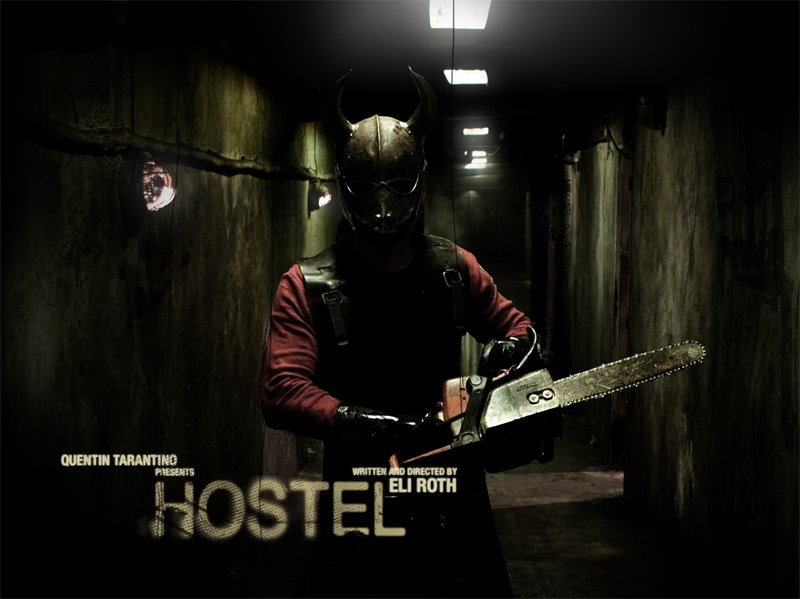
October Challenge: Hostel.


Of all the ways mainstream critics have attempted to demote and denigrate horror films, none has been more successful than the creation of the term 'torture porn.' It's an ugly phrase,  but one that is being used with alarming frequency. According to critics like David Edelstein - the term's creator - 'torture porn' movies like Hostel and its imitators not only  promote sexualised violence, but they actively encourage feelings of vicarious pleasure in its audiences.

In essence: not only are the filmmakers sick, but so are we, the audience, for watching their films.

The term isn't just an insulting and dismissive one, it also indicates just how little mainstream critics understand horror. Hostel is a satire, and an alarmingly effective one at that. It's one of the few American movies brave enough to gaze deep into the machinations of capitalism, globalisation, and the darkness behind our desires, and in that way, it should have been applauded as one of the finest horror films of recent memory.

Instead, it was made to seem like little more than a glorified snuff movie by American critics, and its audience were trivialised. Anyone who liked the film was characterised as a stupid gore fiend, and in that way, the film and its supporters were immediately cast out onto the fringe.


In all seriousness: perhaps Hostel was too subtle for its critics. For all of the movie's confrontational violence and shock, there is an understated nature to the way it develops its themes and characters.

The main element of Hostel that most critics seem to misunderstand is the film's depiction of sex and nudity.  Although they realised that Roth was presenting us with images of nudity and abandon for titillations sake they misunderstood the deeper message.

Roth does encourage us to enjoy to bask in the images of nudity in the film's opening, acting as though he were supporting the hedonistic world view of his characters. But he exaggerates our male-centric, sex obsessed culture to the point where it becomes a parody of itself. In the world of Hostel, beautiful women appear to be charmed by men who draw faces on their asses. Roth presents us with a fantasy pushed to unbelievable limits, not only to visualize and satirise our desires for hedonistic pleasure, but also to set us up for a dark fall.

We are meant to be suckered in by all that flesh so that by the film's midpoint, Roth can neatly turn around and bite us firmly in our sharpie covered butts. He wants us to accept, consciously or otherwise, the ramifications of our desires.

In essence, he wants us the audience to be seduced, and then he wants to hurt us.

A prostitute, and by extension Roth, encouraging the audience into the world of Hostel's seamy imagery.

Studying the sexual aggression of Paxton, one of the film's 'heroes' is a perfect way of seeing how Roth does this. Paxton is a dominator, but by the movie's turning point, he has become dominated. He has an unstated belief that sleeping with women makes them his conquests, an attitude that gets flipped on his head when he is abducted. "You bitch!" He screams at the woman who led him to the 'exhibition' where he will be tortured. "I get a lot of money from you," she replies. "And that make you my bitch."

The central premise of the film's horror - that there are rich men out there willing to pay to torture others - is a neat extension of capitalist thought. When "Edward Saladfingers", informs the boys that with the right money 'you can do anything', our protagonists assume he is referring to sexualised acts. They are comfortable with the idea that money can buy pleasure; they do not realise, as Roth does, that the natural progression of that idea is towards the concept that money can buy pain, too.

The benefit of capitalism is meant to be a kind of democracy - anything can be bought, which means, in theory that anything can be achieved. But Roth sees the insidious suggestion behind all this as well. The torture scenes that define the film's last half are neat mirror images of the scenes of sex that characterised its beginning. By drawing connections between the two, Roth asks where a world that allows bodies to be bought for sex is heading. If human beings are products to be traded and sold, then the lines between damaging your own property and damaging another living thing are disturbingly vague.

In Hostel, the act of inflicting torture is an industry. It has its employees - the women at the hostel, and their drivers - who treat the line of work as though it were no different from any other. There is a great, brief shot of the man who takes Paxton the 'exhibition', joining his co-workers as they stand around their cars and talk. For them, there's no drama to the occupation. It's just a nine to five, rather than a matter of life or death.


The film also attacks the attitudes of Americans when it comes to the rest of the world. The arrogance of the boys comes from their feeling of being privileged citizens of the west - they are Americans, and as a result, they seem to believe that they can laugh at the citizens of poorer countries. They view the world as a zoo which is designed for them alone. When Paxton sees a film playing on a television in the hostel of the movie's title, he barks: "how are we meant to understand this movie without subtitles? Gay." The world, he believes, should be designed for the English speakers.

It is the sick joke that defines the film then, that their arrogance is revealed to be little more than ignorance. They treat the gap toothed pedestrians like harmless kooks. They have grown up and lived their lives in a sheltered world of travel guides and commercials; they believe the world outside America is absurd, but ultimately harmless, and by its conclusion Hostel has punished them for these views in the most deliberately vile ways imaginable. The joke of the film is on them.

It would be wrong of me to imply that Hostel is a purely intellectual film - it's not, and it doesn't mean to be. All this subtext is present, but the movie is also a powerful experience if only viewed on face value. Roth has a masterful control of cinematic violence - he knows exactly how much gore to show, but he never overstates his hand. Indeed, one of the film's most disturbing scenes is entirely bloodless, as a prospective torturer, played by the incredible Rick Hoffman, considers the opportunities for inflicting pain that lie before him.


In short, Hostel, is not only a film deserving of analysis and discussion, it is also impeccably composed.  That is why 'torture porn' is such a useless term. If you're going to simplify such a complex and dark take on American consumerism, why not do the same for all movies? Why not call 12 Years a Slave 'history porn?' Why isn't Schindler's List 'tragedy porn?' Where to draw the line? After all, Casablanca's just 'romance porn': the term 'porn' is only being used to describe filmmakers presenting us with images that invoke a certain feeling or thought. Isn't that the point of all cinema?

In any case, if you're going to reduce and ignore films just because they fit a genre you do not like, then you destroy your own credibility in one single blow.

I suppose I shouldn't be bitter about it. While critics continue to bandy around useless, degrading terms, the rest of us are relishing a film of power, thought and satire. We win.